
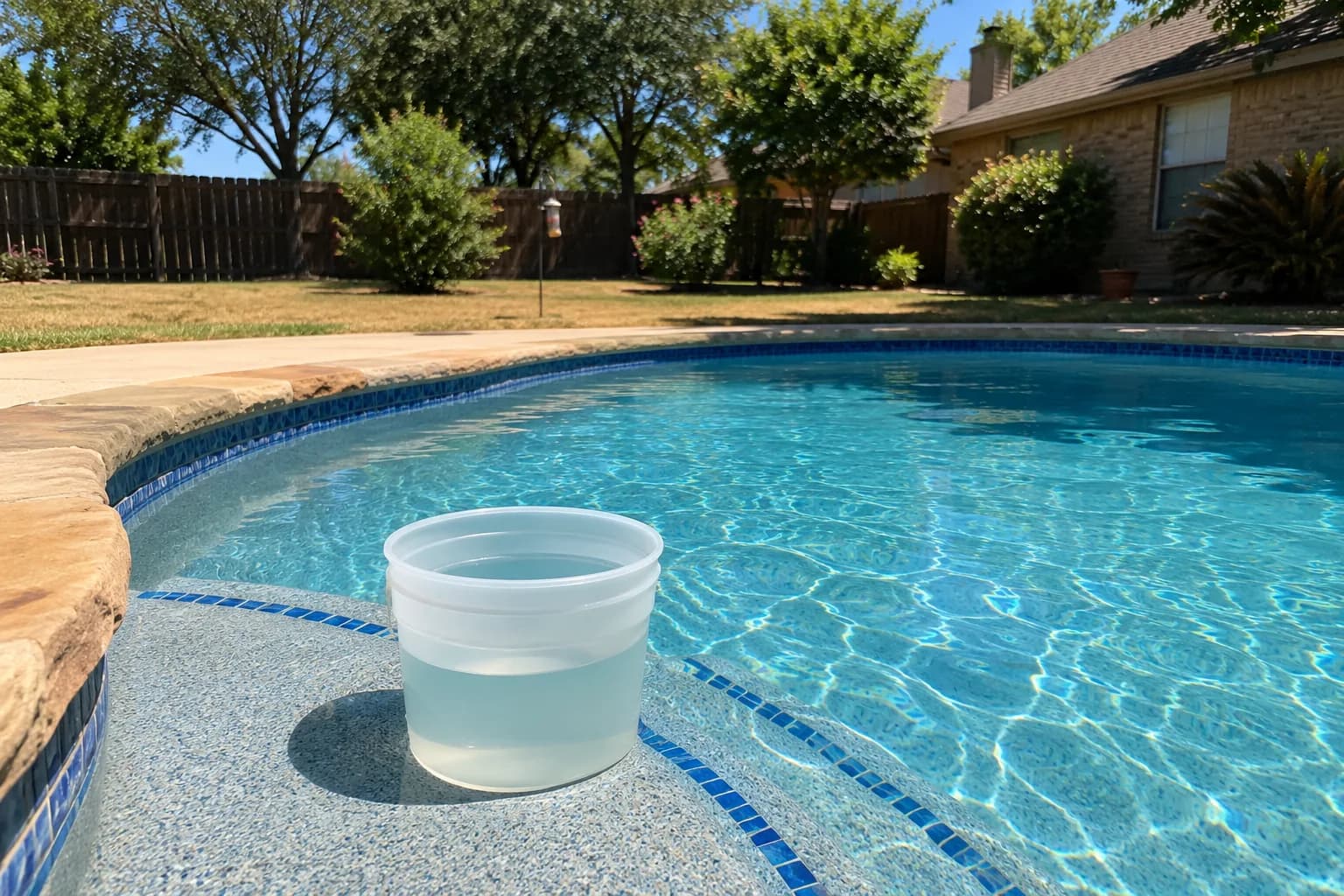
Your pool water is dropping, and you're not sure if that's just summer heat doing its thing or an actual leak eating into your wallet. Pool leak vs evaporation is one of the most common questions we hear at Leak Detectives, whether we're out in Southwest Oklahoma or North Texas. The good news is you don't need a plumber to get a first answer. You need a bucket, some tape, and about 24 hours.
Why Evaporation Fools So Many Pool Owners
Every pool loses water to evaporation. That part is normal. In our region, summer heat combined with wind and low humidity can pull a surprising amount of water out of a pool in a single week.
Typical evaporation rates in our area:
- 1/4 inch per day is considered normal in mild weather
- Up to 1/2 inch per day during hot, windy Oklahoma and Texas summers
- Higher still for pools with water features like waterfalls or fountains, since moving water evaporates faster
Because evaporation can already account for a couple inches a week, homeowners often assume that's the whole story. As a result, real leaks get ignored for months while the water bill quietly climbs.
The Bucket Test: Your First Diagnostic Tool
The bucket test isolates evaporation from everything else so you can compare it directly to what your pool is actually losing. It's simple, but the details matter.
How to Run It Correctly
- Fill a bucket with pool water and place it on a pool step so it's partially submerged
- Mark the water level inside the bucket and the water level in the pool with tape or a marker
- Turn off the pool's auto-fill feature if you have one
- Wait 24 hours without swimming or adding water
- Compare how far each water level dropped
If the pool line drops more than the bucket line, you likely have a leak. If both drop roughly the same amount, evaporation is probably your answer. We recommend running the test twice to rule out wind or a single unusually hot day skewing your results.
Common Bucket Test Mistakes
A lot of homeowners get inconclusive results because of a few avoidable errors. Splashing from kids or pets resets the water level and throws off the comparison. Wind gusts near an uncovered bucket speed up evaporation inside it, which can mask a real leak. And running the pump or auto-fill during the test muddies the numbers before you even start comparing them.
When the Bucket Test Points to a Leak
If your pool is consistently losing more water than the bucket, the next step is figuring out where. Leaks generally fall into a few categories, and each behaves differently.
- Structural leaks in the shell, usually near cracks or where the pool has shifted with the soil
- Plumbing leaks in the pipes running to and from the equipment pad, often underground
- Skimmer or fitting leaks where fixtures meet the pool wall
- Equipment leaks at the pump, filter, or heater connections
North Texas and Southwest Oklahoma both deal with clay-heavy soil that expands and contracts with moisture changes. That shifting puts stress on plumbing lines and pool shells over time, which is honestly why we stay busy here. We've walked onto jobs where the homeowner swore it was evaporation, only to find a cracked return line six inches underground that had been leaking for months.
What a Professional Leak Detection Actually Involves
The bucket test tells you whether you have a leak. It doesn't tell you where. That's where equipment like dye testing, pressure testing on the plumbing lines, and sometimes underwater cameras come in.
During a professional leak inspection, we typically:
- Pressure test the plumbing lines separately from the pool shell
- Use dye testing near suspected cracks, fittings, and light niches
- Check the skimmer throat and equipment pad connections
- Isolate whether water loss continues with the pump off versus running
Skipping this step and guessing at repairs is how homeowners end up patching the wrong spot twice. A pinhole leak in a return line can lose hundreds of gallons a week, and it won't always show visible wet spots in the yard, especially with our clay soil absorbing water before it surfaces.
Signs It's Probably a Leak, Not Evaporation
Beyond the bucket test, a few patterns tend to point toward an actual leak rather than heat and wind.
- Water loss continues even when the pump is off for extended periods
- You're adding more than 2 inches of water per week consistently
- Wet or unusually soft spots in the yard near the pool equipment or shell
- Cracks appearing in the pool deck or coping
- Chemical costs rising because you keep diluting and rebalancing after refills
If any of these sound familiar alongside a failed bucket test, it's worth getting a proper inspection before the leak gets bigger or more expensive to fix.
FAQ
How much water loss is normal for evaporation?
In Southwest Oklahoma and North Texas, expect roughly 1/4 to 1/2 inch of evaporation per day during hot summer months, more if your pool has a water feature. Anything consistently beyond that is worth investigating further.
How long should I run a bucket test?
24 hours gives the most reliable results. Running it for less time can be thrown off by temporary conditions like a gust of wind or a splash from kids playing nearby.
Can a small leak really cause a big water bill?
Yes. A leak losing even a gallon an hour adds up to over 700 gallons a month, and many leaks are larger than that. Combined with the chemicals needed to rebalance refilled water, small leaks get expensive fast.
Does pool color or visible cracks always mean there's a leak?
Not necessarily. Cracks can be cosmetic and not actively leaking, while some leaks show no visible signs at all, especially underground plumbing leaks. That's why professional testing matters more than a visual inspection alone.
What's the difference between structural and plumbing leaks?
Structural leaks occur in the pool shell itself, often from ground movement or age. Plumbing leaks happen in the pipes connecting the pool to the equipment pad, which are usually buried and harder to spot without pressure testing.
Should I keep filling the pool while I wait for an inspection?
You can keep the water at a safe operating level to protect your pump, but avoid overfilling repeatedly without knowing the cause. Document how much you're adding so you can share that information with your technician.
Ready to Find Out for Sure?
If your bucket test came back inconclusive or confirmed a leak, don't wait for it to get worse. Book a consultation with Leak Detectives and we'll pinpoint exactly where your water is going, whether you're in Southwest Oklahoma or North Texas.